Social media was on fire today with the news that precious original documents have been damaged at New Register House thanks largely to indifference.
The building that houses the National Records of Scotland, ScotlandsPeople Centre and the Court of the Lord Lyon was purpose built to preserve the growing number of government documents. The building of what is now General Register House was an 11 year process, from 1774-1785. That was 234 years ago.
New Register House was added in 1869 to provide much needed storage for the documents that were being created following Statutory Registration in 1855. While perhaps a more modern addition, it is still a century and a half old.
Unlike today, in 1869 next to no one in Scotland or elsewhere for that matter cared about genealogical research. Fast forward to 1977 when the western world was gripped by the new "mini series" Roots. That sparked an interest in learning more about our ancestors. The interest in the 21st century, with the easy access to records online and user friendly platforms to assist with building, storing and sharing family trees has grown exponentially.
In response to this came innovation out of Register House in 2002, with the digitization of vital documents and making them available on the world wide web. More innovation in 2007 when dedicated research space was created for people to come in - literally off the street - to research their Scottish ancestors.
The world wide web soared in growth and more and more digitized records became available online. In response, the NRS changed service providers for their online presence, with a promise to bringing large sets of records online. Records such as Kirk Sessions and Court Records. Despite the records already sitting in virtual volumes, the promise of moving them onto the website has been rife with indecision, lack of follow through, lack of open, honest communication and has, ultimately, resulted in a false promise that has never or perhaps will never become reality.
It is this same indecision and lack of follow through that led to the disaster last week of records being damaged as a result of recent torrential rain. Rain isn't new for Scotland. However, as the earth warms, the storms pack a bigger punch. Staff at the NRS noticed that the dome in West Register House sprung leaks whenever the rain was more than what Scotland had been accustomed to in 1869. These same staff raised concern. Repeatedly. And yet, like the promise of large record sets coming online, nothing was done. This indifference, indecision and lack of follow through has now resulted in disaster. Ruined documents.
It's not enough to breathe a sigh of relief that the documents are digitized. They were digitized nearly two decades ago when the technology for digitizing was fairly new. It is not uncommon to find a document that is underexposed, overexposed or otherwise unreadable. When asked, the registrars are incredibly accommodating about returning to the original registers and re-scanning the page (using more modern technology) so that it is more legible. The public has no access to original records if they have been digitized. But the registrars certainly do and their job will be far more difficult as a result of the water damage from the leaky roof that no one took responsibility for fixing.
The mind boggles that in a building full of archivists and registrars, the safe preservation of original documents hasn't been set as priority one. Five years ago, the NRS undertook an Estates Review and recognized the need for a new venue.
We need a new purpose built archives for government documents. One with adequate storage so that records can be accessed within an hour rather than within a day or two. A building without leaky roofs. I think of the Highland Archives in Inverness, the Glasgow Women's Library, the National Library of Scotland and the Mitchell Library when it comes to more modern research space and adequate storage.
While the Highland Archives is a very modern building, the others aren't. It IS possible to have both aesthetics and functionality. But that can't happen with indifference, indecision and lack of follow through.
Pages
Showing posts with label Scotlands People Centre. Show all posts
Tuesday, 30 July 2019
Thursday, 23 April 2015
Two Days of Research at the ScotlandsPeople Centre
We have had two really productive days at the ScotlandsPeople Centre. In addition to the Old Parish Registers (OPRs), Statutory Records (BMD) and Census Records, tour participants were able to view Kirk Session records and to pull books that are held in the library of the ScotlandsPeople Centre.
Gaps were filled in, myths dispelled, questions answered and new information discovered. The best part for most participants was getting confirmation of the research that they had started in North America.
Participants were also able to do research in the Historical Reading Room at the NRS and this was where many of the stories were fleshed out.
We are looking forward to the rest of the week and the information we are able to uncover as we continue our Genealogy Research Tour in Scotland.
Gaps were filled in, myths dispelled, questions answered and new information discovered. The best part for most participants was getting confirmation of the research that they had started in North America.
Participants were also able to do research in the Historical Reading Room at the NRS and this was where many of the stories were fleshed out.
We are looking forward to the rest of the week and the information we are able to uncover as we continue our Genealogy Research Tour in Scotland.
Thursday, 8 May 2014
And The Research Begins
Along with the sightseeing and family get togethers comes the real purpose of our trip - genealogy research.
Tuesday saw us going as a large group to the Scotlands People Centre. Here we were given a family history talk by the Centre Director, Iain Ferguson. He is enlightening and entertaining and we were ready to get tucked into the records after listening to his talk.
There were some computer glitches and the first day was a bit of a learning curve since the system in house is a bit different to the web system.
At the end of a very busy day, it was back to the hotel for some personal time.
On Wednesday, the group was split into two to make the best of the research space at the Scottish Genealoy Society. So first off, half of the group was taken back down to ScotlandsPeople Centre. Some were in the research room downstairs and some made use of the Historical Reading Room and the National Archives upstairs.
Then the other half of the group was taken over to the Scottish Genealogy Society. As we wandered through the Old Town and overlooked the Grassmarket, we were able to learn about the history of some of the buildings along the way to the SGS. Here we were met by Charlie Napier who gave us a short talk on the resources available. This was then followed by a tour of the facilities and then we were able to get down to research.
All too soon, it was time to collect the group from ScotlandsPeople Centre. It turned out to be quite a successful day, with many documents being found. There was lots of laughter as we shared the antics of our forebears.
Then is was a quick walk over to the SGS to gather the group from there. I met up with most of them who were already walking back. They didn't have quite the same success as the group downtown, but enjoyed the day and the stories of the volunteers at the SGS.
Now it was time to grab a quick bite and refresh before heading out on a Resurrectionist Tour of Greyfriars Kirkyard.
Tuesday saw us going as a large group to the Scotlands People Centre. Here we were given a family history talk by the Centre Director, Iain Ferguson. He is enlightening and entertaining and we were ready to get tucked into the records after listening to his talk.
There were some computer glitches and the first day was a bit of a learning curve since the system in house is a bit different to the web system.
At the end of a very busy day, it was back to the hotel for some personal time.
On Wednesday, the group was split into two to make the best of the research space at the Scottish Genealoy Society. So first off, half of the group was taken back down to ScotlandsPeople Centre. Some were in the research room downstairs and some made use of the Historical Reading Room and the National Archives upstairs.
Then the other half of the group was taken over to the Scottish Genealogy Society. As we wandered through the Old Town and overlooked the Grassmarket, we were able to learn about the history of some of the buildings along the way to the SGS. Here we were met by Charlie Napier who gave us a short talk on the resources available. This was then followed by a tour of the facilities and then we were able to get down to research.
All too soon, it was time to collect the group from ScotlandsPeople Centre. It turned out to be quite a successful day, with many documents being found. There was lots of laughter as we shared the antics of our forebears.
Then is was a quick walk over to the SGS to gather the group from there. I met up with most of them who were already walking back. They didn't have quite the same success as the group downtown, but enjoyed the day and the stories of the volunteers at the SGS.
Now it was time to grab a quick bite and refresh before heading out on a Resurrectionist Tour of Greyfriars Kirkyard.
Saturday, 13 July 2013
You Can't Do All of Your Research Online
You will get to a point in your Scottish research where you can no longer get the information you seek online. You will either be looking for records that are too new to be published online, or that are too old to be readily found online. That is when it becomes necessary to either travel to Scotland or to hire a genealogist in Scotland to do the work for you.
At the National Archives, you can access Kirk Session records, Court records, Fatal Accident Reports, Tax records and a host of other information to assist you in really knowing who your ancestors were.
At the Scotland’s People Centre, you can view documents right up to the present day. These can not be copied or downloaded, but you can transcribe to your hearts content.
At the National Library, you can access national and regional newspapers, old maps, historical clubs and society records, emigration lists, trades directories, post office directories and a great deal more.
At the Scottish Genealogy Society, you can view burial records, monumental inscriptions, some trades directories, voters rolls and more.
At the National Archives, you can access Kirk Session records, Court records, Fatal Accident Reports, Tax records and a host of other information to assist you in really knowing who your ancestors were.
Since this is likely to be a once in a lifetime trip, do yourself a favour and know what it is you hope to accomplish and where you can accomplish it. The worst thing you can do is just show up in Scotland and hope for the best. Traveling to the home of your ancestors takes planning. It is not enough to show up in the village, head to the local pub and start asking questions. You need to do some research ahead of time. Learn about what repositories are available, what archival materials they hold, who can access them and what is required to access them (do you need a “readers ticket” or special card? Do you need photo i.d? Do you need to provide passport photos so an i.d. card can be created for you?). Learn the hours that the repositories are open, whether an appointment or booking time is required and whether there are fees involved.
Many archival institutions have their holdings off-site and so it is important that you know this and order ahead so that your time can be well spent and disappointment kept to a minimum. Read up on whether you are allowed to photograph the images, scan the images, download or copy the images. Take your laptop or tablet as well as a USB stick.
A trip to your ancestral homeland is both awe-inspiring and humbling. It provides you with such a deep seated feeling of reverence knowing you stand in the same place where your ancestors walked. The sights, some of the landmarks and the sounds may have changed, but the deep emotion of knowing your great-great anything once stood in the same spot you are now standing in, or worshipped in the same church you are visiting, is incomparable. It helps you put the dates, names and places into perspective. It breathes life into the documents.
Tuesday, 5 June 2012
What I Learned On My Research Vacation
Over the 10 days of my research vacation, I amassed huge stack of certificates, MIs and headstone photographs. I have a better sense of the area where my ancestors lived, having driven out to see the villages listed on the documents. Now that I am back home, it was time to start making sense of it all in a way that was tangible, meaningful and in a way that can be shared with future generations.
One area I chose to focus my research was on my paternal grandmother's family of origin. My paternal grandmother has always fascinated me. Perhaps because I never really knew her, having been only a toddler when she passed away. Although I have taken the Haddow line back to 1680, I have a deep yearning to know more about Maggie and her family.
This photograph has been a source of inspiration. Maggie is in the back row, behind her mother - the woman seated on the right.
When the 1911 census was released, I learned that the little girl in the front, holding the basket, is in fact my aunt. My dad's eldest sister. But what of the other women? Thanks to being onsite at Scotlands People Centre and being able to view documents not yet available online, here's what I have learned:
Two years after their marriage, my paternal great grandmother, Mary (McCabe) Haddow gave birth to a daughter, Jessie. Following the Scottish Naming Pattern, Jessie was named for her maternal grandmother, Janet (Jessie) Lawrie. Baby Jessie was born on December 21st, 1882 at the home of her parents in Mid Calder.
After she left school, Jessie worked as a postal runner. She later married James Sneddon on September 11, 1908 in Mid Calder. James was from Pumpherston, a nearby village. At the time of their marriage, James was a Shale Miner and Jessie was a postal clerk. James and Jessie had a son, George who was born December 6th 1908.
The 1911 census is unique in that it asks the length of the marriage (in this case, two years), the number of children born alive, (the 1911 census for James and Jessie states that there were three children born alive) and how many of the couple’s children are still living. The 1911 census for James and Jessie states that only one is living. This would be young George. This sent me looking at death records for infants. I found that James and Jessie had a set of twins, Walter Haddow Sneddon and Agnes Miller Sneddon, who were born prematurely on March 1, 1910. The young babies died 2 hours and thirty-five minutes after they were born. This must have been devastating for the young family.
On May 31, 1911, Jessie gave birth to another daughter, Mary McCabe Sneddon.
Jessie died at age 72 on May 22nd, 1955. She died at the Royal Infirmary in Edinburgh (right behind the hotel I was staying at). The cause of death listed on her death registration is Myocardial Infarct (heart attack) that she had suffered five months earlier as well as a pulmonary infarct (a lack of oxygen to the lung resulting in tissue death).
After 47 years of marriage, they are buried together with their infant twins in Mid Calder Cemetery. (photo courtesy Scottish Genealogy Society). Jessie is not in the above photo. I believe this photo was taken just prior to the marriage of my grandparents, and by then Jessie was married with a young family.
As for the other sisters, Walter and Mary’s second daughter was Maggie. Maggie was born 10 August 1888 in Kirknewton, Mid Calder. Maggie is my granny. Her history has been well documented for future generations.
Walter and Mary’s third daughter, Elizabeth Brown Haddow, was born on 24 August, 1890. Elizabeth is seen on the 1891 census, along with her parents and her sisters Jessie and Maggie. Elizabeth married Thomas Porteous Nathaniel on December 2, 1910. Thomas was an engineer (journeyman—meaning he had completed his apprenticeship) from Pumpherston. Elizabeth and Thomas had three children: Dunlop (born 1912), Henry (born 10 March 1916) and Walter Haddow (born 1920). Elizabeth died January 25, 1963 at Bangour Hospital . She was 72. Elizabeth ’s cause of death was bronchopneumonia. Her usual residence is listed as 15 Retham Park Pumpherston. The informant of her death (to the registrar) was her son, Henry.
Walter and Mary’s fourth daughter, Mary McCabe Haddow was born 30 March 1893. Mary is seen in the 1901 census along with her older sisters, Jessie, Maggie and Elizabeth as well as with her younger sister, Jeanie. Mary never married. She was known to have had at least one child, daughter Molly (Mary). There is some speculation that she may have had other children as well. Mary died at the age of 70. She was a retired housekeeper at the time of her death. The informant of her death was her daughter, Molly Haddow. Their usual residence was 23 Main St Mid Calder. Molly continued to reside in the home after her mother's death.
Walter and Mary’s fifth daughter, Jeanie McCabe Haddow was born on 18 January, 1899. Jeanie never married. She worked as a canteen manageress (perhaps at the school where Molly also worked). Jeanie died on December 21st 1960 as a result of breast cancer. The doctor noted that the breast cancer had re-occurred after radiotherapy. Jeanie was 61 years of age. She died at home and the informant (to the registrar) was her niece Mary (Molly) Haddow.
The youngest of Walter and Mary’s daughters was Katie Clark Haddow. Katie was born on April 8th 1901. Katie never married. She worked as a domestic. She died on July 31, 1979 of gastric carcinoma at Bangour Hospital . Her usual residence was 23 Main St Mid Calder - the same home as her sister Mary and Mary's daughter Molly.
Walter died at his home on Bank Street in Mid Calder on 24 February 1927 as a result of tuberculosis. He was 64 years of age. The informant of the death is son in law James Sneddon (husband of Jessie). James and Jessie were by this point living at 3 Robertson Ave in Edinburgh . Mary McCabe Haddow died on 19 March, 1945 at her home on Bank Street in Mid Calder. She was 84 and her cause of death was cardiovascular degeneration. The informant of her death was daughter Jeanie. Walter and Mary are buried with their unmarried daughters: Jean, Mary and Kate in Mid Calder cemetery.
(photo courtesy Scottish Genealogy Society)
As a genealogist, I believe in sharing. Not just with other genealogists, but also with family. In order to share what I learned on my research vacation, I prepared and presented this "newsletter" to my paternal cousins so that they may also have the story and so that their descendants will know from whence they came:
Thursday, 10 May 2012
Day Five - Scotland's People Centre
We enjoyed a very productive day at Scotland's People Centre today. We spent the morning in a Family History session, learning about all of the records that are available, then we were able to tuck in and do some serious research.
The wonderful thing about being onsite, of course, is that we can view "modern" records - those too new to be available online. Once the daily search fee of £15 is paid, you are free to view as many records as you can manage. There is a very nominal fee to either photocopy the images or download them to a USB stick. I am at the stage where I need access to the newer records to add foliage to my tree, so spent a lot of time transcribing.
I found one inaccurate record, and one that allowed the puzzle to have a couple of new pieces added to the picture.
By 4:30 my head was swimming with keeping the Marys straight. We headed back to the hotel to re-charge.
At 6:30, it was time to leave for the Stables at Prestonfield and the Taste of Scotland Dinner Show.
We enoyed our choice of Orkney Clapshot Soup or Gamekeeper's Paté, followed by the main course of either braised beef or seafood:
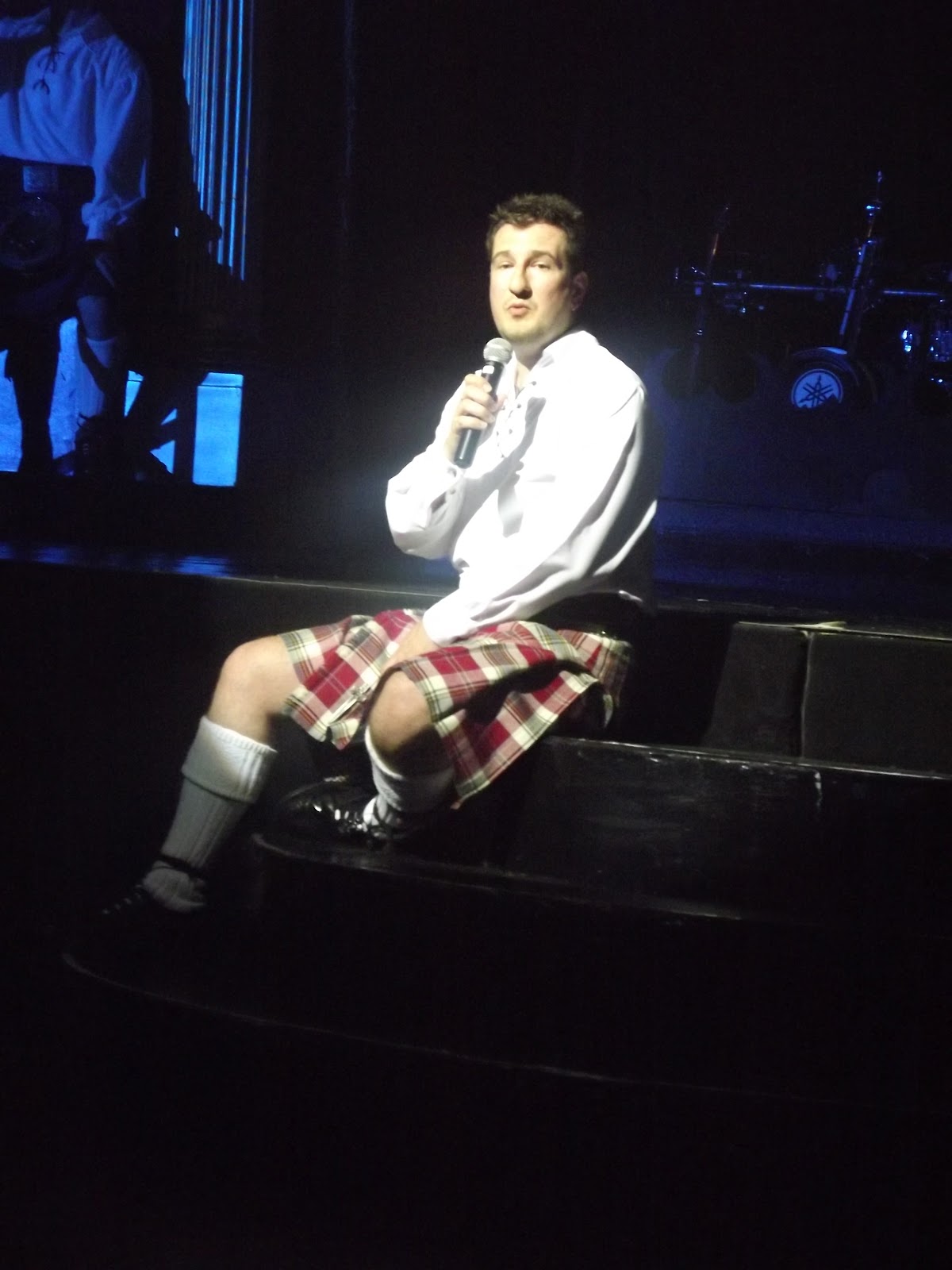
Following dessert, we were treated to a solid two hours of Scottish music (pipes, drums, accordion, fiddle and keyboard)
The wonderful thing about being onsite, of course, is that we can view "modern" records - those too new to be available online. Once the daily search fee of £15 is paid, you are free to view as many records as you can manage. There is a very nominal fee to either photocopy the images or download them to a USB stick. I am at the stage where I need access to the newer records to add foliage to my tree, so spent a lot of time transcribing.
I found one inaccurate record, and one that allowed the puzzle to have a couple of new pieces added to the picture.
By 4:30 my head was swimming with keeping the Marys straight. We headed back to the hotel to re-charge.
At 6:30, it was time to leave for the Stables at Prestonfield and the Taste of Scotland Dinner Show.
Salmon, hake and Finnan haddie in Mornay sauce and encased in puff pastry
Dessert was a very light raspberry Chranancan
song (by Scotland's Three Tenors accompanied by female vocalist Brigid Mhairi)
and dance (The Wee Highlanders and Prestonfield Dancers)
enhanced with video of some of the most stunning scenery in Scotland. The songs also gave a glimpse into the rich and embattled history of Scotland. Just prior to intermission, the haggis was piped in and host Cailean McLean addressed and then toasted the haggis.
During intermission, the audience had the opportunity to sample some haggis, bashed neeps and champit tatties
There was also the opportunity for audience participation during the Gay Gordon's, a sing-a-long and for Auld Lang Syne
The Taste of Scotland Show reminded me of Hogmanay parties at my mum and dad's. For anyone with Scottish ancestry, the Taste of Scotland Show is a must see.
Thursday, 23 February 2012
The Itinerary for the Spring Tour is Now Confirmed.
We will be staying in Edinburgh. The hotel is the Residence Inn by Marriott in Edinburgh . This is located less than a mile from Scotland ’s People Centre, the National Library and the Scottish Genealogy Society. Since our days at each of these places are long, the closeness of the hotel makes it easier for people to take a break and return to the hotel if they wish.
The Residence Inn is an “apart-hotel” which means that it has a full kitchen as well as a sleeping area. Given that we are away for 10 days, this will make it feel less like we are living out of a suitcase for the time we are away. The rooms are studio rooms with a bed, kitchen area (fridge, dishwasher and microwave) and an area where you can set up to do your research or have a “mini office” without having to have things all over the floor, dresser or bed. The rooms have wireless internet. There is a laundry room on the main floor of the hotel.
A full hot/cold breakfast is available every morning. There are a number of eateries within a few blocks of the hotel. Two within a couple of blocks are the Witchery and the Tower. Both highly recommended. Some of the restaurants will deliver to the hotel residents free of charge. The hotel also offers a free grocery delivery service so that you can cook your own small meals or snacks should you prefer.
May 6th: this is a day of travel for you to get to Scotland (travel arrangements made on your own)
May 7th: The tour begins today. You will be met at the airport in Glasgow and will be taken to the hotel in Edinburgh . Please ensure I have your flight arrival details.
May 7th is a bank holiday. Banks, post offices and other government buildings will be closed. The afternoon will be free time to enjoy the city, take a city tour, or to rest after the long flight and 5 hour time change. The evening will be spent at the Taste Of Scotland Dinner show.
May 8th: Following breakfast, we will be taken over to the Mitchell Library in Glasgow. There are a number of computer terminals at the Mitchell and there is high speed Wi-Fi in some areas of the library should you choose to take your laptop. There is a café onsite for lunch and dinner. The café is open until 7:15 pm. We will be at the Mitchell until 8pm when it closes.
May 9th: Following breakfast, we will be taken to Scotland ’s People Centre. Here we will enjoy a Family History Event, which is not only an introduction to the facility but a workshop on Scottish Research as well. Coffee and tea will be provided during this event, which will run the entire morning. Your research days are paid for as part of your tour fees. However, you will be on your own to pay for any copies you make or for saving images to your USB stick (the USB stick will be provided to you). Photocopies at Scotland 's People Centre are £.50 and saves to the USB stick are £.30. We will be at Scotland ’s People Centre until 4:30 when we will return to the hotel. There is a café onsite for a light lunch. We return to Scotland ’s People Centre at 6:30 for an evening of research. The café is not open at night.
May 10th: Following breakfast, we will return to the Mitchell in Glasgow for a full day of research.
May 11th: Following breakfast, we will return to Scotland ’s People Centre for a full day of research. We will return to the hotel at 4:30. Anyone wishing to be away for the weekend to visit the place where their ancestors lived may get a head start on the Friday night if they wish.
The weekend is open for anyone wishing to travel or sightsee. There are a number of organized day tours leaving from Edinburgh for anyone wishing to join them. They can be booked once we are in Edinburgh (the tourist information is directly across the street from Scotland ’s People Centre). Tours to the highlands are popular, as are trips to Stirling Castle , St Andrews or Roslin Chapel and the Scottish Borders. Most of the tours run about £30 – £40 for the day. Well worth the money.
For those choosing to stay in Edinburgh , I highly recommend the Edinburgh City Tours. They are on an open top, double decker bus. The best way to make use of the tour is to stay on for the full circuit (about an hour). Then, stay on the bus and travel to the attractions of interest. The tours are hop-on/hop-off so once you are finished at one attraction, you simply board the next bus and head to the next area of interest. Edinburgh Castle is a must see. However, it involves a lot of walking and the esplanade is cobblestone, which makes the walk a bit more difficult. The Royal Mile from the Castle to Holyrood House (the Queen’s residence when she is in Scotland) is amass with small shoppes, museums and closes (small, dark crowded streets) that offer a great day of history and discovery.
On the main street in Edinburgh, Princes Street, there are the famed Gardens, shopping and the Scott monument. The Edinburgh City Tour tickets are £12 and are good for 24 hours, so you don’t need to rush to see everything on the first day.
Monday May 14th: Following breakfast, we will head to the Scottish Genealogy Society. The fees for your day are covered in your tour fees. The SGS has a subscription to both Ancestry.co.uk and FindMyPast. You will be able to access these subscriptions during our visit. The SGS also has records pre-1855 which will assist you in getting further back in your family tree. Here is a list of what is available to you: http://www.scotsgenealogy.com/Resources.aspx
We will be at the Scottish Genealogy Society from 10:30 – 5:30. We will return to the hotel and then get ready for dinner at Dalhousie Castle on the outskirts of Edinburgh. Dinner is in the Dungeon restaurant and will begin at 7 pm. http://www.dalhousiecastle.co.uk/fine_dining.asp?Page=the_dungeon_restaurant
May 15th: Following breakfast, we will be taken to the National Library. Here we will have an overview of what resources are available followed by a tour of the public areas of the library. You will require a temporary library card in order to research here. You can do this ahead of time, if you wish at: http://www.nls.uk/using-the-library/library-cards
Many of the items are off site but can be made available to you if the Library is aware in advance that you will require them. Here is the link to see what is available: http://www.nls.uk/family-history
We will be at the Library from 9:30 – 8:30. There is a café onsite for lunch and dinner. If you are interested in historic maps, they are in a separate building, joined by a walkway, which closes at 5pm. Again, you can contact the library ahead of time to make sure the items you are looking for will be available to you.
May 16th: Following breakfast, we will check out of the hotel and transfer back to Glasgow airport.
I am looking forward to our time in Scotland. Happy Researching!!
Subscribe to:
Posts (Atom)